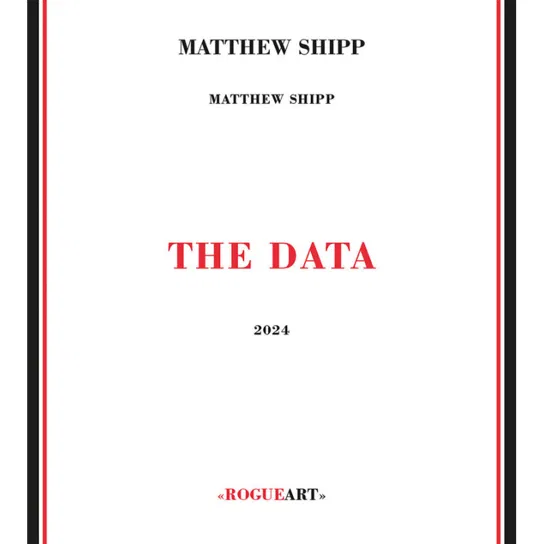
The Data
Informacje szczegółowe
Pokaż wszystkieKażdy sprzedawca w empik.com jest przedsiębiorcą. Wszystkie obowiązki związane z umową sprzedaży ciążą na sprzedawcy. Za wysłanie produktu odpowiada sprzedawca.
Opis produktu
muzycy:
Matthew Shipp: piano solo
Tracklista:
1. The Data #1 03:23
2. The Data #2 07:47
3. The Data #3 10:27
4. The Data #4 04:33
5. The Data #5 06:57
6. The Data #6 03:35
7. The Data #7 05:17
8. The Data #8 03:44
9. The Data #9 04:20
10. The Data #10 03:44
11. The Data #11 07:31
12. The Data #12 04:34
13. The Data #13 01:43
14. The Data #14 05:19
15. The Data #15 06:39
16. The Data #16 03:35
17. The Data #17 04:53
Editor's Info
Recording in the Merkin Concert Hall on a Steinway Grand Piano, New York pianist Matthew Shipp's seventeen numbered tracks of "The Data" takes listeners through a virtual history of jazz and contemporary improvisation, from beautifully lyrical moments to rapidly complex matrices of expression, balancing his approaches into an absorbing and rewarding album.
freejazzblog:
Matthew Shipp has been such a prolific recording artist that it is not always easy to keep track of everything he puts out, let alone determine which albums are the real gems - the ones deserving to go down in history as essential. In fact, we are bound to wonder whether a work-based approach is at all appropriate to assess his creative output: shouldn’t we rather adopt, as Brian Morton has suggested regarding Ivo Perelman’s enormous discography, a process -based one? (That is, to look at Shipp’s output not as a collection of individual works, but as an organically evolving whole.) I’d say yes and no. For, as I see it, music criticism should seek to integrate both approaches: on the one hand, even in the case of someone like Craig Taborn, of whom I can confidently pick Avenging Angel as a definitive masterpiece, a process-based approach is nonetheless required; and, on the other, Perelman himself has made records which ought to stand out somehow - take, for instance, all-time classics such as Seeds, Vision and Counterpoint or Suite For Helen F.
Anyway, I’m happy to report that, like his recent New Concepts in Piano Trio Jazz and Magical Incantation, this new solo album is among the real gems. A couple of years ago, The Piano Equation struck me as being possibly the ultimate Matthew Shipp solo piano statement, but I’m now inclined to think The Data might even surpass it.
First of all, for a rather straightforward reason: the album’s sheer sound, vastly different from - and, in my mind, superior to - the majority of Shipp’s recordings. Instead of the usual studio recording, with the piano very closely miked, this one was done at Merkin Concert Hall, in New York City, with its beautiful Steinway grand being given considerably more breathing space: while Randy Thaler’s engineering still sounds relatively close, seldom have I heard Shipp’s quirky chords resonate so naturally, and his starker dynamic contrasts are very nicely rendered (“The Data #11” is a case in point). Thanks to this factor, I think I’m yet to hear a more authentic document of Shipp’s sonority, that unmistakable blend of the kind of full-bodied percussiveness we associate with Black Mystery School pianism and the crystallinity of a classical touch - almost as if Mal Waldron and Michelangeli had been merged into a single pianist.
The second reason, somewhat harder to pin down, has to do with what this album, recorded back in mid 2021, represents in terms of the evolution of Shipp’s equally unmistakable language. He has been a radically original voice for a long time, but here I feel he has taken yet another step in terms of carving out a niche for himself within the music universe - so much so that the tracing of any supposed influences has become an increasingly nuanced (and elusive) affair, hardly helped by generalities such as, say, “Black Mystery School pianism meets French impressionism.” (I even hear echoes of Janáček in the haunting “The Data #12”.) While this review is not the place to pursue such exercise in any meaningful way, I’d like at least to point out that, although Monk’s ghost is likely to keep hovering over Shipp’s playing, this struck me, overall, as one of his least Monkish performances. And, as paradoxical as it may sound, that places him even higher in the gallery of Monk’s heirs: for being a worthy heir of Monk is far from merely being stylistically influenced by him in relevant ways; it is also, and above all, to be a radical iconoclast.
Perhaps for that reason, I found this album harder to rate than most, which is why I have refrained from doing so, at least for the time being. For, in a way, Shipp now only competes with himself (or his former and future selves). I also found it hard to single out particular tracks: like the little squares of a Jack Whitten painting, each has its own character and might thus be contemplated individually, but they all belong to a larger - largely abstract - whole.
Now, is this an album of jazz piano? Again, yes and no. The jazz language is, of course, among the key components of planet Shipp, but it is far from the only one. And, crucially, such components - the data he collects while immersed in his (fully spontaneous) creative process - are not merely added to each other, qua building blocks. Rather, they interact organically so as to end up being transformed by each other, amounting to a singular type of avant-garde music, at once Black and universal.
By João Esteves da Silva
allaboutjazz:
Music is communication, and jazz, especially jazz improvisation is the purest form of expression of one's intercourse. Think of this in terms of the contrast between Buddy Bolden, who is believed to be the very first jazz musician and Mick Jagger of The Rolling Stones. Bolden began playing Gospel, blues, and marching band music, but his performance was not limited (critics have debated whether he could read music) to the notes on the page. Nonetheless, Bolden improvised, changed tempos, and made his music an expression of his identity. The Stones, having consumed American blues, created an enterprise by repackaging the music as rock-and-roll. The difference between Bolden and Jagger is the divergence of listeners' expectations. Concertgoers demand The Stones' music sound just like it does on the albums and just the opposite expectations for a jazz performance.
Making it new and original is the beauty and genius of The Data, the solo recording by pianist Matthew Shipp. His discography of nearly 300 recordings includes an apprenticeship with the legends David S. Ware and Roscoe Mitchell, duos with William Parker, Joe Morris, and Ivo Perelman, his quartet, and dozens of piano trio sessions. It is though, with the solo outings, listeners get the raw essence of Matthew Shipp. Beginning in 1995 with Before the World (FMP, 1997) and Symbol Systems (No More Records, 1995) reissued in 2018 on hatOLOGY, Shipp has released a dozen-plus solo recordings. Recorded at Merkin Concert Hall in New York on a Steinway grand piano in June of 2021, he is gifted with ideal conditions. Shipp is given a blank canvas in which to paint upon. The seventeen tracks, each individual points of "The Data" are spontaneous exclamations, even (dare we say, ejaculations from his mind.
Like Bolden, we are presented with the essence of Shipp. The music is raw data and each track is the datum that makes up his concepts. His decades of practice and performance yield a sound that is part advanced math and part passion. He can weave improvised chamber music with the animating principles of Thelonious Monk and Horace Tapscott. Those comparisons do not do justice to the original sounds generated by this 21st-century master improviser. Connoisseurs of Shipp's music will recognize phrases, expressions, and other fragments of datum from his illustrious career, all prologue to this inspiring performance.
By Mark Corroto
Informacje szczegółowe
| ID produktu: | 1716640126 |
|---|---|
| Tytuł: | The Data |
| Wykonawca: | Shipp Matthew |
| Dystrybutor: | |
| Data premiery: | 2024-01-01 |
| Rok nagrania: | 2024 |
| GPSR - osoba odpowiedzialna i certyfikaty: |
Oceny i recenzje o produkcie
Nikt jeszcze nie dodał recenzji tego produktu.
Bądź pierwszy!Twoja opinia będzie bardzo przydatna dla innych użytkowników.